

Creating the ideal web user experience—one that facilitates business success and conversions—often necessitates iteration and design testing. In the past, the cost of testing different web configurations was considerable, as substantial modifications to a website’s structure necessitated expensive CSS and coding adjustments. However, the drag-and-drop canvases, custom page layouts, and configurable content management systems of automated web builders such as Squarespace, Wix, WordPress, and Webflow enable marketing departments, web design teams, and individual designers to create and edit websites without writing a single line of HTML or CSS code toptal.com.
Daily24blogs | thenextmoments | growingbaker | travelstray | interiordesignforhome | lifepointcity | JustLifePhoto
For businesses principles of design, the capability to swiftly construct, introduce, and enhance landing pages, blogs, and websites is an additional significant benefit. Webflow features case studies on its website, including one in which a client constructed websites four times more quickly and another in which conversions increased by over 25%. I am convinced by these accounts. I have used Webflow to design several custom sites for clients and to create a web-based portfolio template for creative professionals in just five days, as a freelance UI/UX designer with a decade of experience coding websites from inception. By halving the time required to design a website, the tool has significantly revolutionized my workflow. As a result, I am now able to allocate more attention to the landing pages and interactive components that generate organic traffic and enhance conversion rates toptal.com.
Although automation may appear menacing to seasoned designers and developers, I have personally discovered it to be extraordinarily empowering. This article examines Webflow capabilities and best practices in greater detail toptal.com, focusing on how to implement them to achieve business success.
Ease Of Optimization
An initial client website that I developed utilizing Webflow belonged to a Serbian business consultancy that specialized in tax and legal counsel. The client desired a self-hosted website with fewer than ten pages that could be developed in weeks on a shoestring budget. It had to be entirely managed by existing nontechnical personnel to prevent the company from having to engage new personnel. Additionally, the website needed to be aesthetically pleasing, incorporating a font family, color scheme, assortment of photographs, and understated animations that mirrored the brand’s affable and reliable nature. Because of these factors, Webflow was an effective solution.
As I had done previously with clients and former employers, I initiated the endeavor in the same manner. In close collaboration with the leadership team, I formulated a design strategy that included a well-defined target market and objectives. I then constructed wireframes in Balsamiq and a master page of reusable design elements in Figma. By importing these components into Webflow via a plugin and grouping them into custom classes, I ensured that the site had a unified, streamlined appearance.
During the phases of refinement and optimization for principles of design, the project deviated from my prior web design experience. Upon importing my design assets into Webflow, I found its drag-and-drop interface to be extraordinarily intuitive for real-time component addition, rearrangement, and organization. Historically, engaging in such experimentation necessitated the manual coding of modifications, followed by the tedious and time-consuming task of navigating between an HTML display and a browser window in order to monitor my progress.
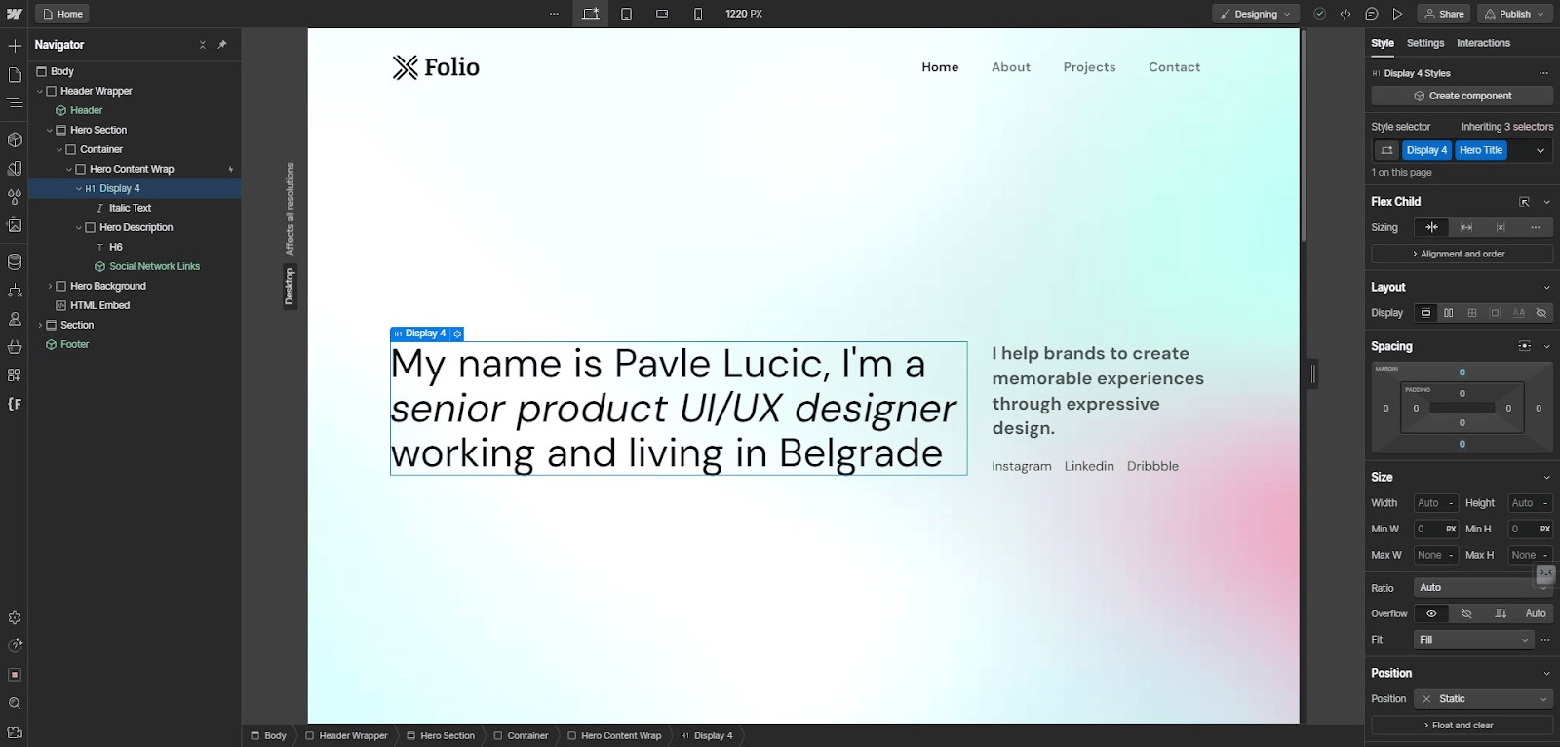
In Webflow’s interface you can design a page and see the changes in real time. (Pavle Lucic)
I also utilized Webflow’s preview and testing utility for responsive designs. On the basis of their perceived value to users, Google and other search engines crawl and index websites. Websites that demonstrate rapid load times and automated device-specific display adjustments are ranked higher in search engine results pages. Given that mobile devices generate over 50% of all web traffic and that Google primarily indexes search results using the mobile version of a site’s content toptal.com, responsive design has emerged as an increasingly significant factor in enhancing website visibility, load times, and click-through rates.
Webflow employs CSS media queries and four predefined templates—desktop, tablet, mobile, and large screen—to guarantee that the font sizes, layout, and images of your website appear standardized and comprehensible across various devices. Webflow performs the coding of breakpoints and definition of element scaling principles, eliminating the need for manual intervention. In addition, a layout tool and the ability to evaluate the site’s appearance on multiple devices and modify the margins and grids are provided. I suggest that, in addition to examining the Webflow preview principles of design, you test your website on a variety of real devices so that any issues can be identified and resolved.
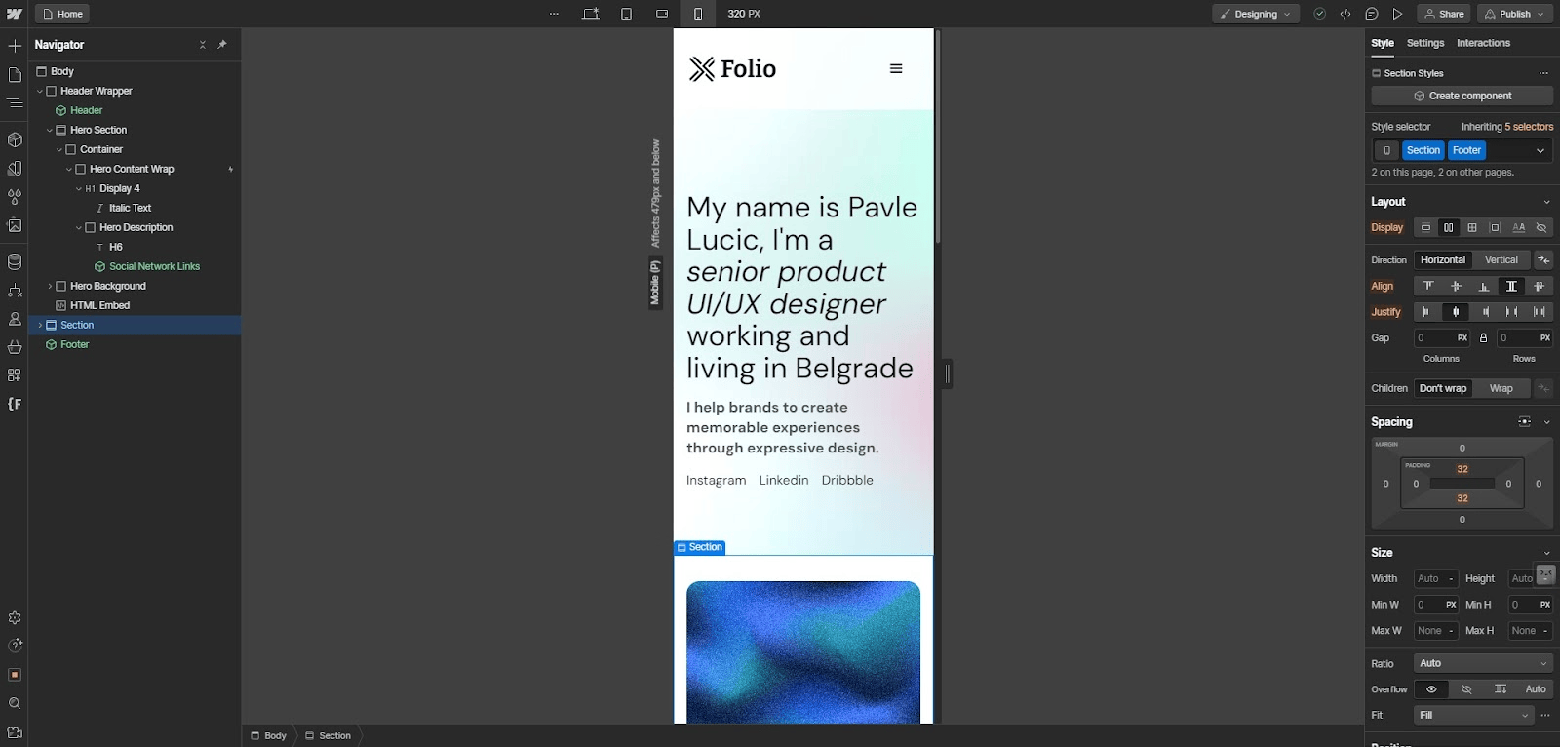
This preview of a mobile view in Webflow shows how you can check a website’s appearance on various devices and make adjustments if needed. (Pavle Lucic)
Although the primary objective of the consultancy client was to have a site that was functional and efficient for revising and adding articles and SEO content, the leadership also prioritized providing a dynamic user experience. Consequently, I utilized the hover and scroll-based interactive elements of Webflow, including videos, light boxes, and animations. I effortlessly incorporated an animated tile containing staff profile photographs that, when the cursor was moved across the faces, created the illusion of tilting on a two-dimensional plane toptal.com. The animation, while inconsequential, effectively captured users’ interest by emphasizing the staff’s friendliness. Additionally, it incentivized visitors to spend more time on the webpage and, if sufficiently intrigued, register for complimentary consultations, which served as a crucial initial measure for the consultancy to acquire fresh clientele.
Enhance Cooperation
Despite the fact that collaboration is an absolute necessity for any design project, communication processes and file sharing can quickly become disorganized and perplexing. Version control is a critical concept that becomes evident upon encountering a file bearing the designation “Final Final Second Draft.” Webflow’s Workspaces feature enables concurrent collaboration among multiple users on a single project, much like Google Docs. Upon receiving an invitation to the workspace, members of the team are able to modify and update files live, provide feedback on particular page components, and communicate with colleagues through direct or group messaging. By utilizing a shared file as a singular source of truth, the confusion that can result from multiple revisions circulating across departments and distributed teams can be avoided.
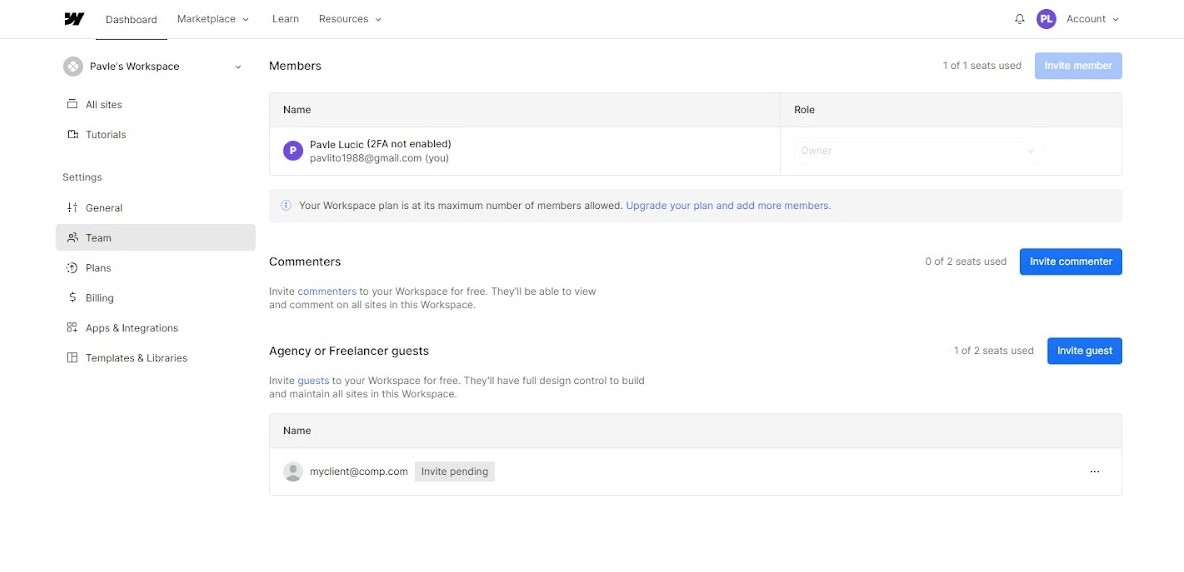
Webflow’s Workspaces dashboard allows you to invite collaborators to review and comment on content. (Pavle Lucic)
I especially value the manner in which the explicit role and permission configurations in Workspaces delineate the obligations of the design team—thereby averting power struggles and safeguarding against work being overridden. An additional productivity-enhancing collaboration tool is one that enables page branching, which enables multiple designers to concurrently work on distinct pages without impacting the live site.
Webflow, in my experience principles of design , enables content and product marketers, strategists, and copywriters to concentrate on their core competencies: writing and editing. By utilizing user-friendly front-end editing tools, the content team can modify excerpt boxes and add video animations to product pages without the need to contact an engineer. An individual or team can use Webflow’s built-in content management system (CMS) to update blogs and website copy, organize and upload photos and videos, and compose alt text for images once they have been allotted an editing role.
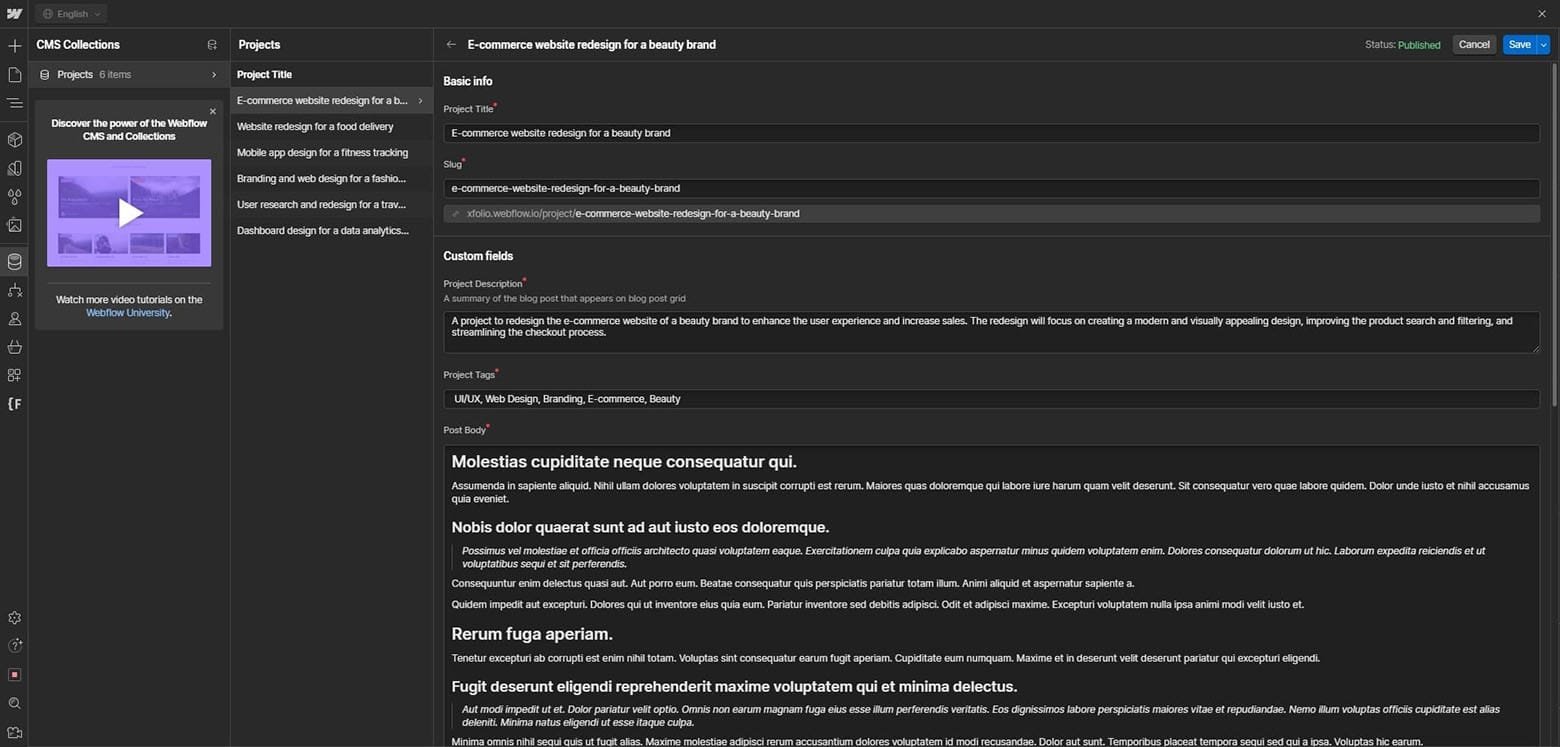
Team members without a design or engineering background can create and edit content in Webflow’s CMS. (Pavle Lucic)
Reach and Conversion Maximization
Alongside the development of a visually appealing and functional website, one must locate and oversee the numerous data sources and tools required by clients to continue operating their sites beyond the conclusion of the project. This can present a formidable challenge. Fortunately, Webflow consolidates a multitude of monitoring tools and integrations into a single location toptal.com.
principles of design, I once integrated a third-party translation provider into a client’s Webflow site in order to facilitate multilingual support. By implementing this straightforward yet effective resolution, the website of the client was rendered accessible to a more extensive global user base. Furthermore, by integrating with prominent e-commerce platforms like Shopify and WooCommerce, you can grant your clients the ability to manage their online stores, synchronize product catalogs, and execute orders all from a solitary dashboard.
By integrating Webflow with analytics and reporting services such as Google Analytics and Hotjar, it is possible to assess the efficacy of a website’s design . One example of how data can be utilized to identify specific pages and components that require enhancements in user experience and usability is through the utilization of heatmaps, anger clicks, and bounce rates.
After establishing integrations for a client’s website, I incorporate new functionalities and features, including social media feeds, email opt-in forms, and product pages. Integrations may also be used to streamline operations and reduce the time required for tasks such as social media posting and newsletter distribution.
I also utilize the fine-grained front-end SEO controls of Webflow to increase the traffic to my clients’ websites toptal.com and improve their search engine rankings. One can optimize a website with minimal dependence on engineering support or external extensions by utilizing accessible menus and semantic controls for image sizing, page titles and descriptions, meta descriptions, URL redirects, and loading preferences.
A final point, a hosting stack powered by AWS and distributed across one hundred data centers guarantees sites load quickly and can manage heavy traffic (one of the factors that attracted my consulting client). In addition to benefiting site visitors, this capability improves the rankings of clients’ websites in search engines whose algorithms consider page load speed.
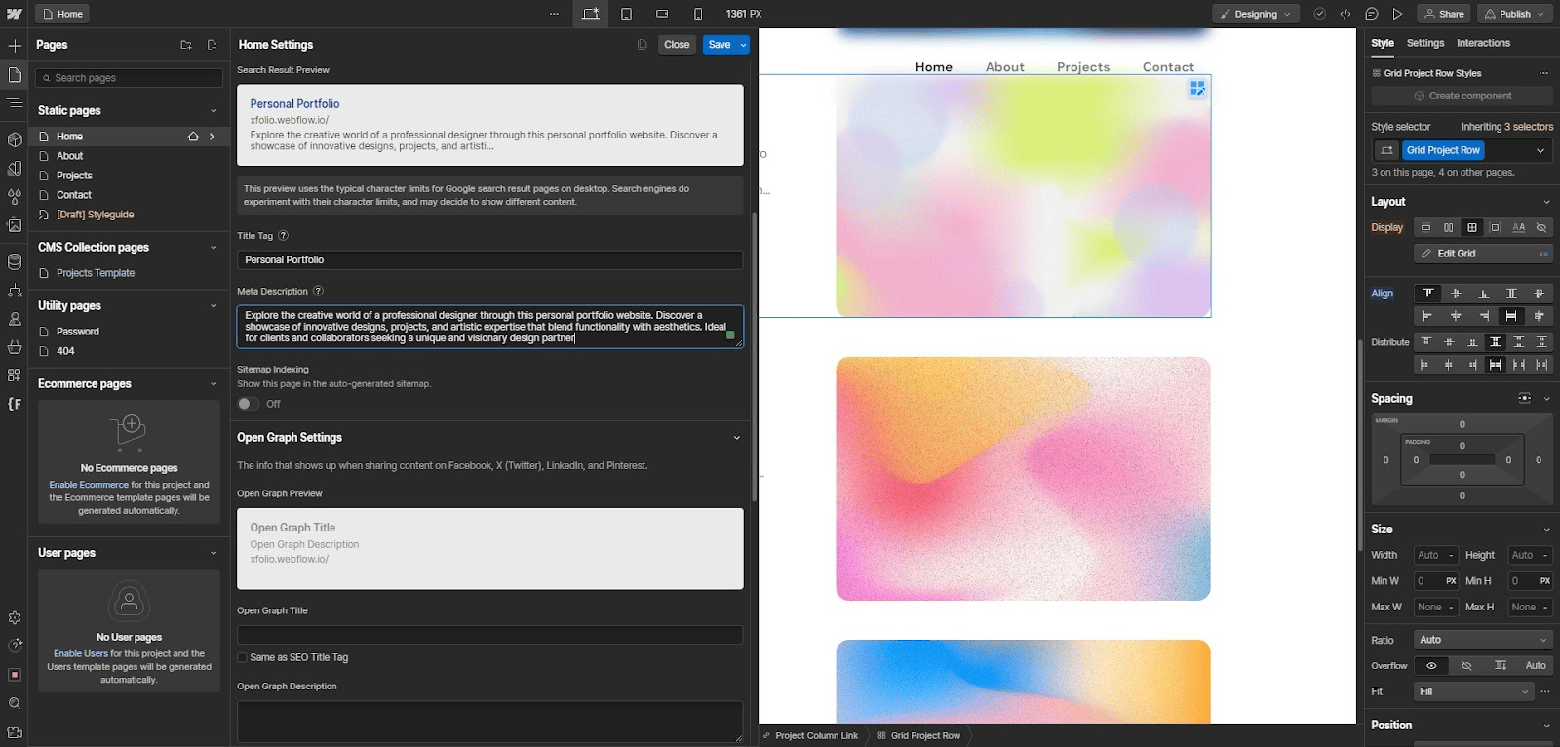
Fundamental SEO configurations in Webflow’s CMS, such as title tags and meta descriptions, can impact the click-through rate of Google search results. (Pavle Lucic)
https://www.toptal.com/designers/ui/principles-of-design

