
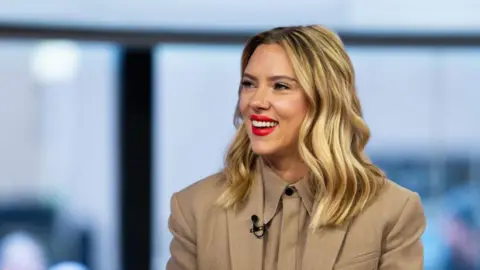
Scarlett Johansson, a Hollywood actress, expressed her horror and indignation at OpenAI’s debut of a chatbot that had a voice that was “eerily similar” to her own.The actress said that she had previously declined the company’s request for her voice to be used in their new chatbot, which reads text to users aloud.
Upon the release of the new model last week, observers were eager to draw parallels between Johansson’s performance in the 2013 film Her and the chatbot’s “Sky” voice.
On Monday, OpenAI declared that the voice will be eliminated, but they emphasised that this was not an attempt to be a “imitation” of the celebrity bbc.
Nonetheless, in a statement obtained by the BBC on Monday night, Johansson charged that the business, along with its creator Sam Altman, had intentionally mimicked her voice.
She added, “I was shocked, incensed, and in disbelief that Mr. Altman would pursue a voice that sounded so eerily similar to mine when I heard the released demo bbc.com.”
“Mr Altman even insinuated that the similarity was intentional, tweeting a single word ‘her’ – a reference to the film in which I voiced a chat system, Samantha, who forms an intimate relationship with a human bbc.com.”
In the 2013 movie Her, which takes place in the not too distant future, Joaquin Phoenix develops feelings for the Ms. Johansson-voiced operating system of his gadget.
The actress, who is up for two Academy Awards, revealed that Mr. Altman had first asked her to provide the voice of the new chatbot back in September bbc.com.
“[Mr Altman] told me that he felt that by my voicing the system, I could bridge the gap between tech companies and creatives and help consumers to feel comfortable with the seismic shift concerning humans and AI,” Johansson stated in an email.
“He said he felt that my voice would be comforting to people .”
However, she revealed that she ultimately turned down the offer due to private concerns bbc.com.
She said that Mr. Altman had gotten in touch with her agency two days prior to the launch of the Sky chatbot, imploring
Johansson to change her mind about her earlier reluctance to work with the company.
The actress continued by saying that she had been compelled to retain solicitors and that, in order to prove how the voice had been created, she had written two legal letters to the business bbc.com.
“In a time when we are all grappling with deepfakes and the protection of our own likeness, our own work, our own identities, I believe these are questions that deserve absolute clarity,” she stated.
Mr. Altman refuted claims made by OpenAI to the BBC that the business attempted to mimic Johansson’s voice.
“The voice of Sky is not Scarlett Johansson’s, and it was never intended to resemble hers,” he stated.
“We hired the voice actor who would play Sky’s voice before contacting Ms. Johansson. We have temporarily stopped utilising Sky Johansson’s voice in our products out of respect for her. We apologise to Ms. Johansson for our poor
communication.
In a separate post on X, formerly Twitter, the company claimed it was “working to pause” the voice until it responded to
inquiries on the selection process.
OpenAI said in a blog post that the five voices sampled by its chatbot came from voice actors in collaboration with the company.
Copyright issues
It happens almost half a year after performers decided to call off their strikes, which caused the entertainment sector to come to a standstill in protest of inadequate compensation and restrictions on the use of artificial intelligence.
Last year, Ms. Johansson participated in an industrial action regarding the use of artificial intelligence (AI) by studios to mimic the voices and faces of performers bbc.com.
A commitment was made to the studios that they would not be used without the performers’ permission.
Dan Stein, CEO of AI voice licencing startup Voice-Swap, stated, “To use someone’s voice without permission feels particularly invasive at a time when distrust of AI and concern over its potential harms are rampant.”
“Whether OpenAI trained their new Sky voice using audio from Scarlett Johansson or a sound-a-like, the fact remains that she refused permission and her identity was exploited regardless.”If the industry leader acts in this manner, it creates a risky precedent for consent and copyright.”
OpenAI has been facing a number of legal challenges about its use of internet copyrighted content.
The New York Times announced in December that it will file a lawsuit against the company on the grounds that it trained its ChatGPT AI model using “millions” of articles published by the media outlet.
Additionally, writers John Grisham and George R. Martin said in September that they intended to file a claim in response to claims that their copyright had been violated in the process of training the system.

