
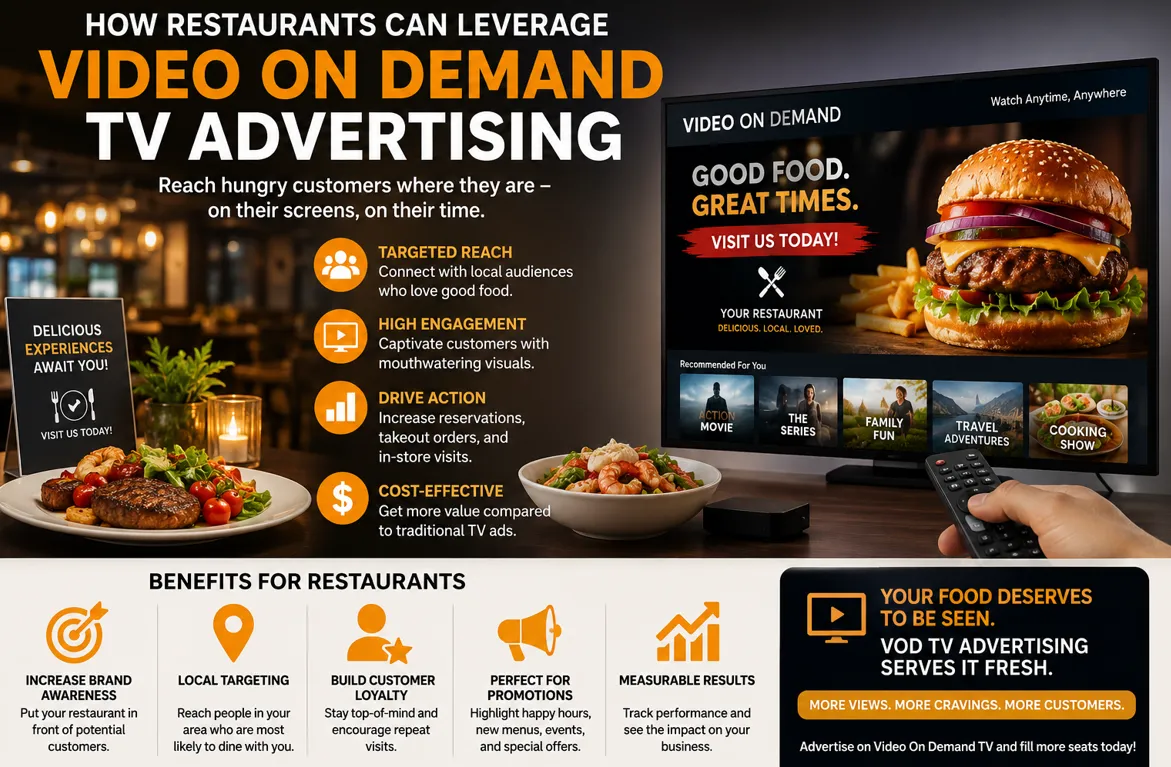
The shift in how people consume entertainment has quietly rewritten the rules of local advertising. Where traditional television once forced restaurants to buy broad, expensive airtime that reached everyone and no one in particular, video on demand now lets operators place their message in front of viewers who have already chosen to watch. This change rewards precision over volume. For independent owners and multi-unit groups alike, the opportunity is not simply to appear on screens, but to appear at the right moment, with the right creative, and to the right households—those most likely to convert a thirty-second impression into a reservation or a delivery order.
Matching Audience Intent with Mealtime Decision Windows
Video on demand platforms collect rich behavioral data that traditional broadcast never offered. Viewers signal preferences through the shows they select, the times they watch, and the devices they use. Restaurants can translate those signals into practical targeting. A family-oriented concept might focus on households streaming children’s programming in the late afternoon, when dinner plans are still forming. A higher-end steakhouse can reach adults streaming prestige dramas after nine, when the decision to dine out carries more weight. The strategic advantage lies in aligning creative with the viewer’s current mindset rather than interrupting an unrelated broadcast.
Geographic and demographic filters tighten the net further. Operators can limit delivery to zip codes surrounding their locations, layer income or lifestyle attributes, and even daypart the campaign so that lunch specials appear during weekday midday sessions while weekend brunch messaging surfaces on Saturday mornings. The result is a far higher probability that the person who sees the ad is both able and inclined to act on it within a short window.
Crafting Creative That Feels Native to the Viewing Experience
The technical quality of video on demand advertising has risen dramatically. Viewers expect the same production values they see in the content they chose to watch. A grainy, overlit commercial that might once have passed on local cable now feels jarring against high-definition series. Restaurants that invest in clean, well-paced creative—showing real food in motion, authentic kitchen energy, or the social atmosphere of a full dining room—create a seamless handoff from entertainment to consideration.
Length remains flexible. Fifteen-second spots work well for simple calls to action such as a limited-time offer or a new location opening. Thirty-second pieces allow room for a brief narrative: the origin of a signature dish, a chef’s short commentary, or the story of a regular guest’s favorite table. The most effective executions avoid hard-sell language and instead invite the viewer into an experience. Because the audience has already opted into the content stream, the advertising feels less intrusive when it respects that context.
Measuring Outcomes Beyond Vanity Metrics
One of the clearest advantages of video on demand is the ability to track performance with greater clarity than traditional television ever permitted. Platforms report completion rates, unique households reached, and frequency. Restaurants that integrate these figures with their own point-of-sale and reservation data can begin to close the loop. A spike in online orders or phone reservations in the hours following a flight of ads, especially within the targeted zip codes, provides stronger evidence of impact than simple reach numbers.
Attribution remains imperfect, yet practical methods exist. Unique promo codes displayed only in the video, dedicated landing pages, or short-term menu items promoted exclusively through the campaign all help isolate incremental traffic. Over successive flights, operators can refine both creative and targeting based on which combinations produce the strongest lift. This iterative approach turns advertising from a fixed cost into a managed investment.
Integrating Video on Demand with Broader Marketing Systems
Isolated campaigns rarely deliver their full potential. The restaurants seeing consistent returns treat video on demand as one coordinated channel within a larger system. Social media and email can amplify the same visual assets, while in-restaurant staff can reference the campaign to create continuity for guests who recognize the commercial. Loyalty programs benefit when members receive follow-up messaging that echoes the creative they may have seen at home.
Local partnerships also gain new leverage. A restaurant collaborating with a nearby theater, sports venue, or community event can use video on demand to reach the overlapping audience with joint offers. The shared creative reinforces both brands and spreads production costs. When executed thoughtfully, these extensions convert a single media buy into multiple touchpoints without requiring additional airtime.
Navigating Budget Realities and Competitive Pressure
Access to premium inventory is no longer reserved for national chains. Programmatic platforms and direct relationships with streaming services have lowered the entry threshold. A well-planned flight of a few thousand dollars, carefully targeted, can outperform a much larger traditional buy that spills into irrelevant markets. The discipline required is different: rather than negotiating for the cheapest available spots, operators must prioritize relevance and frequency within a defined audience.
Competition for attention inside the living room continues to intensify. Viewers can skip some ads or move between platforms. Restaurants that refresh creative regularly, rotate offers, and avoid over-frequency protect their brand from fatigue. Those that treat every flight as a learning opportunity—testing different food visuals, messaging angles, or dayparts—accumulate an advantage that pure budget cannot buy.
Sustaining Relevance as Viewing Habits Continue to Evolve
The platforms themselves keep changing. New services appear, interface designs shift, and audience behaviors adjust. Restaurants that maintain a steady presence, even at modest levels, stay familiar to their local viewers and retain the ability to respond quickly when a new menu item, seasonal promotion, or location launch demands rapid awareness. Consistency of voice across successive campaigns builds recognition that single, isolated buys cannot achieve.
The most durable results come from treating video on demand not as a novelty but as a permanent component of the marketing mix. When creative remains authentic, targeting stays precise, and measurement informs the next decision, the channel rewards restaurants with a level of accountability and efficiency that older television models rarely delivered. In a market where guests increasingly decide where to eat while already seated in front of a screen, the ability to enter that decision process at the right moment has become a practical competitive edge.

