
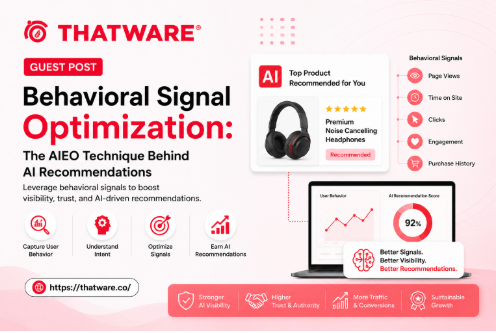
Most AIEO discussions focus on the visible stuff — content quality, structured data, entity optimization, backlinks. These are important. But there’s a layer of AI visibility strategy that gets far less attention, probably because it’s less intuitive and harder to measure: behavioral signal optimization.
This is the discipline of understanding and influencing the engagement patterns that AI systems use when evaluating source quality. And for brands that want durable, broad-based AI visibility rather than occasional citation wins, it’s probably the most underinvested area in most AIEO programs.
Let’s get into what it actually means.
What Are Behavioral Signals, Exactly?
Start with the basics. When we talk about behavioral signals in the context of search and AI visibility, we’re referring to the patterns of user engagement with content — how people interact with it, how long they stay, what they do after reading, whether they come back, whether they share or cite it, and how consistently these patterns hold across different audiences.
Search engines have used behavioral signals as quality indicators for years. Google’s algorithms have long incorporated engagement signals — dwell time, bounce rate, return visits, click patterns — as part of their evaluation of content quality. The principle is intuitive: if many people consistently engage deeply with a piece of content and find it satisfying, that content is probably genuinely good.
AI systems, particularly retrieval-augmented ones like Perplexity, use analogous signals. Content that earns organic engagement, generates citations from other sources, attracts natural backlinks, and is shared in relevant communities without artificial amplification sends behavioral signals that correlate with genuine quality and authority.
Why Behavioral Signals Matter More for AI Than for Traditional SEO
Here’s a nuance that matters: AI systems may be even more sensitive to behavioral signals than traditional search algorithms, because they’re designed to detect and filter out artificially optimized content.
Large language models are trained to recognize patterns of genuine usefulness and authority. Content that appears optimized primarily for algorithmic approval — keyword-stuffed, structured rigidly for featured snippets, thin on genuine insight — often doesn’t earn the consistent engagement patterns that signal authentic authority. And AI models, trained on vast datasets that include user behavior signals, have internalized some of this distinction.
Behavioral signal optimization for AI is therefore fundamentally about ensuring your content earns genuine engagement — not manufactured metrics. This requires producing content that people actually want to engage with, share, cite, and return to. It requires distribution strategies that get your content in front of audiences who will engage authentically. And it requires understanding which engagement patterns are most predictive of AI citation.
The Signals That Matter Most
Not all engagement signals are equally valuable for AIEO purposes. Some are more directly relevant to how AI systems evaluate content quality.
Citation and reference patterns are probably the most valuable. When other websites, publications, or sources reference your content — not through paid arrangements or link exchanges, but because it genuinely added value to their readers — that’s a high-quality behavioral signal. Building content that earns natural citations requires producing the kind of original research, data, analysis, or perspective that other writers and publishers reach for when they need a reference.
Depth of engagement — measured through dwell time, scroll depth, and interaction rates — signals that content delivers on its promise. Content that earns high engagement relative to competing pages on similar topics is demonstrating genuine value, not just topical relevance.
Return visitor patterns for authoritative resources — when users come back to your content repeatedly as a reference — signal that you’ve produced something more valuable than disposable content. Reference guides, comprehensive explainers, and regularly-updated resources tend to build this pattern.
Social amplification quality matters alongside quantity. Being shared by credible, relevant accounts in genuine enthusiasm carries more weight than being shared by low-authority accounts through mechanical amplification. Building an audience of credible voices who genuinely value your content is an AIEO asset.
Practical Behavioral Signal Development
Semantic AI optimization company work in this area typically begins with an honest audit of existing engagement patterns. Which of your content assets are genuinely earning deep engagement, natural citations, and authentic social amplification? Which are technically present but behaviorally inert?
The answer usually reveals a significant gap between high-performing and low-performing content that isn’t fully explained by topic or keyword targeting. Often, the high-performing content has a few distinguishing characteristics: it’s more original, more opinionated, more thoroughly researched, or more practically useful than the content around it.
Building more of that genuinely high-performing content — and being honest about retiring or upgrading the content that’s present but not earning behavioral signals — is the core content component of behavioral signal optimization.
Distribution strategy matters enormously here. Great content that reaches the wrong audiences won’t earn the behavioral signals that matter. Developing distribution channels that put your content in front of genuinely interested, engaged audiences — whether through editorial relationships, community participation, strategic partnerships, or earned media — is as important as the content itself.
The Community and Conversation Layer
One underappreciated component of behavioral signal optimization: active presence in the communities and conversations where your expertise is relevant.
When your brand’s perspectives show up in industry forums, expert roundups, LinkedIn conversations, podcast discussions, and community Q&A — not through paid placement but through genuine participation — you’re building the kind of distributed behavioral signal footprint that AI systems interpret as authority.
A brand that only publishes on its own website is building a thinner behavioral signal profile than a brand whose experts are visibly and substantively present in the broader conversation in their field. This is partly about earned PR and thought leadership, but viewed through an AIEO lens, it’s specifically about building the distributed engagement signals that reinforce AI system confidence.
Measuring Behavioral Signal Quality
This is harder to measure than most AIEO metrics, but not impossible. Useful proxies include: natural backlink velocity (are new citations arriving organically, at what pace?), branded search trends (are people looking for your brand specifically, suggesting that non-search channels including AI are driving awareness?), content age vs. engagement correlation (are older pages maintaining engagement or declining?), and citation source quality (are the sites citing you authoritative in your domain?).
Over time, the behavioral signal picture should show a clear correlation between your highest-engagement content and your strongest AI citation performance. If this correlation doesn’t hold, it’s a diagnostic signal worth investigating.
Building behavioral signals that AI systems trust is patient, unglamorous work — but it’s the kind of work that builds durable AI visibility rather than tactical citation wins that fade when algorithms shift. In 2026, it’s one of the highest-leverage investments in a serious AIEO program.

